

Call Us For Consultation (312) 427-6163
Immigration News and Updates
Ukraine TPS: Six-Month Work Authorization Indicated, but Employer Verification Guidance Lags

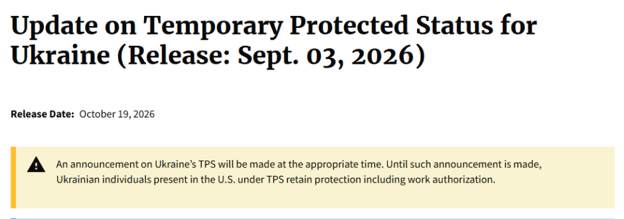
As Ukraine’s Temporary Protected Status (TPS) designation approached its October 19, 2026, end date, the Department of Homeland Security (DHS) spokesperson informed news agencies that the protection would continue, rather than end immediately, although an official announcement extending TPS “will be made at the appropriate time.” The DHS spokesperson said covered Ukrainians could remain in the United States pending this delayed announcement, and USCIS subsequently confirmed that Ukrainian TPS beneficiaries retain protection, including work authorization, until an announcement is made. These communications indicate continued benefits, but they have not yet taken the form of a published notice establishing a new designation period or specifying how employers should document continued work authorization.
Although USCIS has indicated it will update its Ukraine TPS guidance shortly and that work authorization will continue for six months, the delay in officially announcing its extension nevertheless creates risk and confusion for employers. USCIS’s Ukraine TPS page says beneficiaries retain protection, including work authorization, pending a further announcement, while still listing October 19, 2026, as the designation’s end date. It does not identify a new six-month employment-document expiration date.
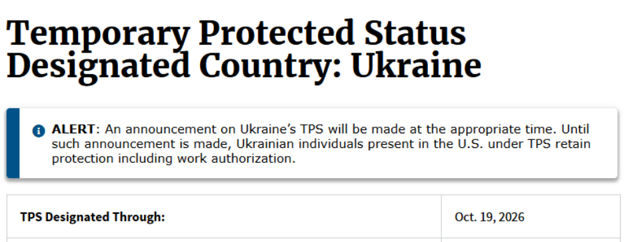
The USCIS’s E-Verify site contains an identical message regarding TPS for Ukraine.
The distinction matters. The TPS statute provides for a six-month extension of a country’s designation in the circumstances described in INA § 244(b)(3)(C), and provides that employment authorization remains effective while an individual is in TPS. But an extension of a designation is not necessarily an instruction to treat every previously issued Employment Authorization Document (EAD) as unexpired for six more months. The employment-authorization regulation, 8 C.F.R. § 244.12(a), requires renewal when the authorized period expires and the country’s designation has not terminated; it does not itself supply a blanket six-month extension of all TPS EADs.
That leaves an immediate Form I-9 question. USCIS’s existing Ukraine-specific I-9 guidance still instructs employers to use October 19, 2026, for the qualifying EAD-and-notice combinations it addresses, including when entering an expiration date in E-Verify. Its general TPS Form I-9 guidance directs employers to look to the applicable published automatic-extension information to determine whether an expired EAD remains acceptable. Neither instruction yet tells employers which Ukraine TPS documents, if any, should be recorded as valid for a new six-month period or what date to enter after October 19. USCIS needs to specify the covered documents and the date and method employers should use for reverification and E-Verify.
Employers should distinguish a beneficiary’s continuing authorization to work from the separate question of how to document it for Form I-9. They should monitor USCIS’s Ukraine TPS and I-9 pages, retain dated copies of relevant agency statements and review each employee’s available documents under the applicable verification rules.
Key Takeaway
For now, employers should keep two related but separate questions in mind:
- Does the employee still have TPS and work authorization? Yes, based on current USCIS and E-Verify messaging (above). Ukrainian TPS holders remain protected and can keep working while DHS prepares its announcement.
- What documents serve as evidence of this work authorization on Form I-9? This part is less clear. DHS hasn’t yet published updated I-9 instructions, new EAD validity dates, or a Federal Register notice covering this period.
MMH is closely monitoring DHS, USCIS, E-Verify, and the Federal Register, and we will send updated guidance as soon as formal instructions come out.

CONTACT US TODAY
Our office will contact you to schedule a consultation with one of our attorneys. Please note a consultation fee will apply.


sign up for
our newsletter
NUVEW | Copyright 2026. All Rights Reserved | Accessibility Notice | Privacy Policy
Attorney Advertising. This information is designed for general information only. The information presented should not be construed to be formal legal advice nor the formation of a lawyer/client relationship. Past results and testimonials are not a guarantee, warranty, or prediction of the outcome of your case, and should not be construed as such. Past results cannot guarantee future performance. Any result in a single case is not meant to create an expectation of similar results in future matters because each case involves many different factors, therefore, results will differ on a case-by-case basis. By providing contact information, users acknowledge and give explicit consent to be contacted via the methods of communication provided, including SMS. Message and data rates may apply. Message frequency may vary. Reply STOP to opt out.